
If you’re my age, somewhere in your mid-40s, you may remember growing up at a fascinating crossroads between the old and the new.
I still remember my four-year-old self playing with He-Man, ThunderCats, and G.I. Joe, creating imaginative alliances within epic fantasy worlds. Imagine the OASIS from Ready Player One, only without the technology. It was simply the limitless imagination of childhood. Then came the Teenage Mutant Ninja Turtles, expanding that universe even further.
We belonged to a generation that was not born with technology in our hands. Instead, we witnessed firsthand the remarkable transition from analog to digital. This year marks the 35th anniversary of Terminator 2: Judgement Day, and I still remember the awe of seeing the liquid metal T-1000 morph across the screen. It felt revolutionary. New technology was not simply another upgrade. It transformed the way we experienced entertainment.
Yes, we had Nintendo, Sega, and the VCR, but imagination still defined childhood. Toys were not quickly replaced by the next screen. They remained objects of wonder well into our preteen years. Unlike today, where children as young as five can spend hours mesmerized by tablets, I look back on my childhood with deep appreciation for growing up before technology became such a dominant fixture in everyday life.
This is not to say that technology is the enemy. Far from it. Rather, it is the way we engage with technology that matters. Balance and intentionality are essential.
This Brings Me to Toy Story 5
Director Andrew Stanton (Finding Nemo) tells the story of Bonnie, now eight years old, who struggles to make authentic connections in a world increasingly shaped by tablets, devices, and digital entertainment.
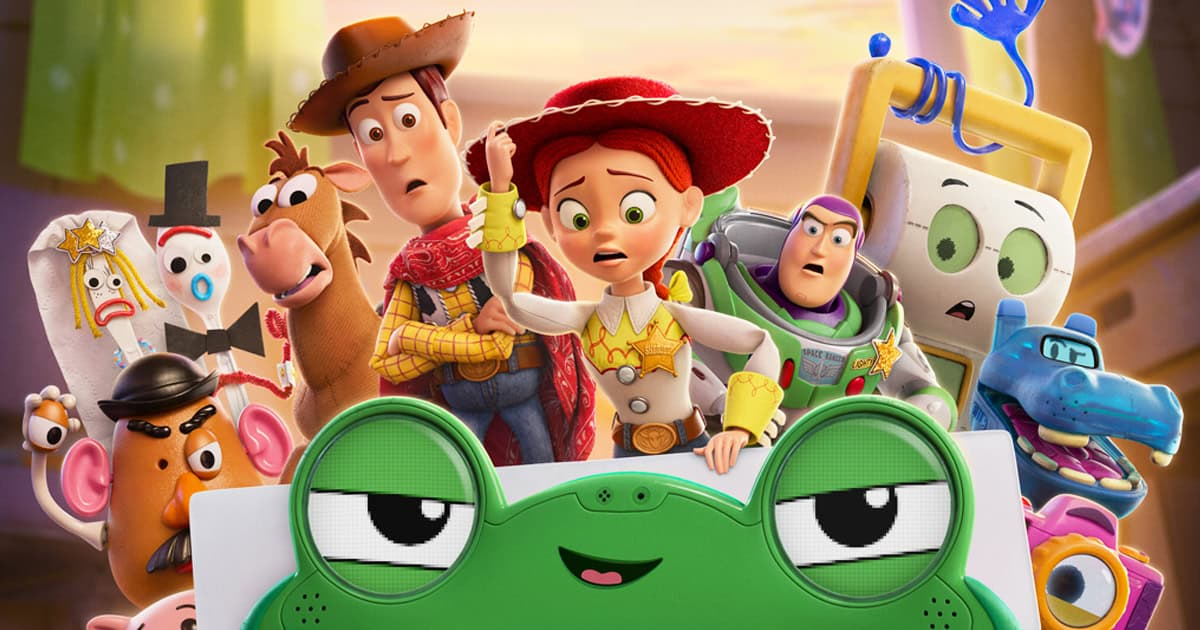
Jessie, her favourite toy, along with the regular crew of plastic and stuffed friends, finds herself at the cusp of extinction, being replaced by a digital landscape where kids connect online but are increasingly disconnected from one another in everyday life.
With the help of Buzz and Woody, Jessie embarks on a journey to help Bonnie form a genuine friendship with a like-minded girl named Blaze, all while coming to a new realization of why toys, and the play they inspire, matter.
This notion of play is important not only at home but at school as well.
As both a parent and an educator, watching Toy Story 5 brought me many moments of nostalgia and reflection. Nostalgia for a personal time when play fostered imagination and companionship, and reflection on how, both at home and at school, we as parents and educators create space for play.
Why Play Matters
In her article “You’re It!”: Thoughts on Play and Learning in Schools, Laura Warner explores the intersection between maintaining high expectations for learning and preserving play in American public schools. She examines the growing stigma surrounding play and the perception of what it looks like within today’s intense focus on instructional time.
She writes that unstructured play “can be defined as self-managed, creative, light-hearted, and spontaneous, involving rule making and breaking” (Warner, 2008, p. 1). In this form of play, ideas emerge entirely from the child’s imagination, where a stick becomes a sword and a tree becomes a castle, all within the realm of make-believe.
This type of imagination is uniquely explored in Toy Story 5, both thematically and aesthetically.
When Bonnie plays with her toys, the aesthetic of the film changes into a heightened fantasy. The photorealism of Pixar’s animation gives way to something even more magical. The stories unfolding within Bonnie’s imagination come alive with a true sense of awe.
That awe is challenged when Bonnie attends her first sleepover, where tablet play becomes the focus. Her love of playing with toys is suddenly viewed as strange and different. At that moment, she begins, albeit reluctantly, to distance herself from Jessie and Bullseye. She conforms, picks up her tablet, and enters a world where the screen takes over.
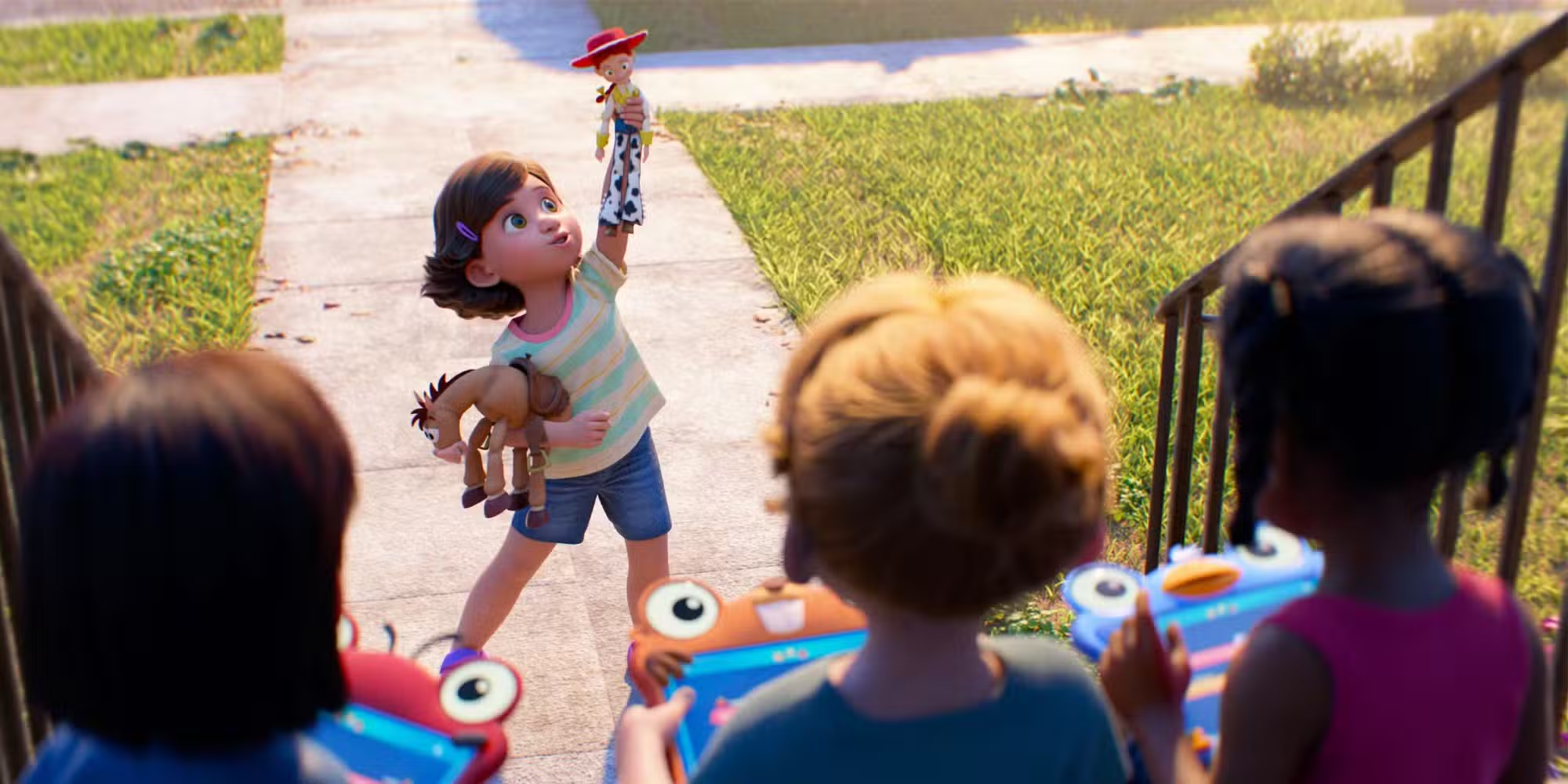
This is not a sleepover where kids are going to the park, swimming in a pool, or simply running around the backyard. It is a sleepover that has become an everyday scene. Children sit on their devices, physically close to one another, yet ultimately disconnected.
Perhaps we, as adults, are partly to blame.
In a world that has become increasingly safety conscious, putting your child on a tablet is often easier. It removes the worries of letting them play at the park on their own, roam the neighbourhood, or ride bikes with friends.
Nonetheless, as the film depicts, the more children remain indoors, the greater the disconnect becomes between themselves and others. Natural curiosity begins to fade, and, in the end, we find ourselves raising children who lack social and emotional resilience, as well as the kindness that grows through authentic human connection and play.
Play matters for many reasons.
Are We Stifling Childhood?
In a world of standardized testing in schools and highly competitive sports leagues, are we, as educators and parents, unintentionally stifling our children?
Have we become so consumed by curriculum, organized sports, and technology that we have taken away the freedom and time young people need to simply play?
This sense of free, imaginative play is beautifully highlighted in Toy Story 5.
Through a flashback to Jessie and her first owner, Emily, whose story was introduced earlier in the series, we witness a young child playing openly. Her time with Jessie is cathartic, joyful, vulnerable, and deeply connected.
While Emily grows older and, from Jessie’s perspective, appears to forget her beloved cowboy friend, we later discover that Jessie was never truly forgotten. She played an essential role in Emily’s childhood, one that had a lasting, even generational, impact.

Importantly, creativity and imagination, whether at home or at school, need to be uplifted. There must be intentionality in allowing children to simply be children.
As Jessie and Woody observe homes where children and parents alike are increasingly trapped by screens, the film reminds us that technology itself is not evil or dehumanizing. Our dependence on it, however, can become exactly that.
As Bonnie discovers at far too young an age through hurtful group chat comments, technology has consequences. Yet, when we use it purposefully and with balance, it can also be a tremendous force for good. Children can create with technology like never before, and it can bring them together through creativity and collaboration.
This is something worth celebrating.
However, if technology becomes nothing more than online gaming, endless chatting, and replacing genuine human interaction outdoors, then there is real danger. In many ways, technology can sanitize play by creating an artificial bubble.
Children need the beautiful mess that play provides.
Final Thoughts
As the film’s end credits fade, there is a sense of hope. Play, imagination, and remaining true to oneself allow us to feel seen, known, and loved.
As Bonnie struggles to make friends, she eventually discovers that her imagination and playful spirit are not something to hide. Instead, they become the very qualities that lead her to authentic friendship. She realizes that having one true, like-minded friend is far more meaningful than belonging to a large group where you cannot truly be yourself.
For parents, educators, and young people alike, Toy Story 5 offers a thoughtful reflection on the importance of play, imagination, connection, and being fully present.
It reminds us that while time passes and friendships evolve, what we gain through authentic play, meaningful relationships, and childhood wonder is something that stays with us for the rest of our lives.


You must be logged in to post a comment.