Other than comic-book inspired movies, horror continues to resonant in theatres during the pandemic. In the past nine months, horror has dominated the box office with The Quiet Place 2, Candy Man, The Conjuring : The Devil Made Me Do It,Halloween Kill and Scream doing solid business at the box office during various COVID waves, reinforcing that horror movies are best “experienced” within the shared space of the movie theatre.
In fact, the key element missing from Netflix’s Texas Chainsaw Massacre “requel” are the shared gasps, screams and screen taunts that come with every horror movie. Like Halloween (2018) and Scream (2022) before it, Texas Chainsaw Massacre is a “requel” that strives to tell a continuing story grounded in franchise lure all while being connected to legacy characters (the OGs of the franchise) and new additions that aim to extend the universe.
For example, Scream released this past January, is not merely “Scream 5,” but a reconfiguration of the franchise in that it reaches back to the original. As a teen character articulates in the film, it’s all about the requels. Like with Jamie Lee Curtis returning to Halloween, Scream creates a world where the franchises can continue within the new confines of genre.
Thus, to fully appreciate Netflix’s Texas Chainsaw Massacre gore-fest is to first understand that franchises like genres will evolve with audience taste and cultural sensibilities. This is illustrated in this new Texas Chainsaw Massacre in that a group of millennials aim to gentrify a Texas ghost town only to discover a Trumpian presence. The ghost town, straight out of an old b-movie western, is where Confederate flags still hang and the trauma of body horror remains.
This notion of body-horror, a horror sub-genre, is about the fear of the human body being dismantled and rampaged. In this regard, Leatherface is the perfect analogy for our populous, COVID and war-torn times. Our bodies, our most personal belonging, is in threat and obscurely not our own. Whether it’s Leatherface as a symbol of Deep South racism or an unforgiving and unbiased disease like COVID, harm is inevitable and viewers are forced to encounter the bloodshed directly.
This is all to say that Netflix’s rendition of Learherface is not the elevated horror that Tara (Jenny Ortega) speaks of in the opening of the new Scream (2022). Rather it’s a b-movie, grind-house throwback, to 80s horror that was unapologetically violent and shocking. Thus, as you manage the bloodshed, keep in focus the world that Leatherface rises out of. His world is very much our own.
As Dr. Anne Lancashire asserts in the video below, all popular film rises from the political. With this understanding comes the need to be intentional in thinking and to look beyond the blood and discomfort that any horror film delivers .
Although this Texas Chainsaw Massacre is far from a masterpiece, it’s a must watch for anyone looking for a couch jolt or cringe.
It seems that late 2021 was Will Smith’s time to remind both readers and movie watchers that destiny doesn’t come by accident. Rather, who we are, want to become and where we want to be is far from accidental. It’s an intersectional journey where goal setting, planning, adapting, perseverance, relationships and unadulterated hard work come together to make success happen.
From the telling of his personal story in the autobiographical bestseller Will to the award darling King Richard, it’s quite clear that Smith (now 53) is transitioning from a man in black and bad boy to an introspective father and husband who is starting a unique chapter in his life grounded in the power of vulnerability.
Specifically, in King Richard, which is the type of drama that would be a major blockbuster in a Pre-COVID theatrical world, Smith effortlessly morphs his natural charisma with the edginess of a trauma inflicted father who is planning big for his children all while navigating realities of race and class in America.
King Richard tells the story of the Williams family and the journey that Venus and Serena Williams took to become professional tennis legends. Coached at an early age by their father and supported by a close knit family, the sisters were transformed into elite athletes who had to bare the brunt of multiple complexities.
From finding their place in white tennis society, to a father parenting through his own experience of racial trauma, the story told in King Richard is a timely reminder that so we haven’t come very far with activating on the promise of equality. Although, the Williams found their support system and one the film depicts as trust worthy, the layers of difference makes for an inspiring story of how a Black father had to protect his children and how his children also earned the right to stand and speak for themselves.
Inspiringly, King Richard transcends race and is very much a master class on fatherhood. As a father watching, I had incredibly empathy for Richard Williams and how he had to navigate moments that tore at his dignity. Yes, it’s patriarchal but as a father you yearn to protect. This is amplified when you are a father to a daughter. Thus, I found so much of myself in Richard Williams. The father who was / is afraid of how the world will impact his daughter and equally how his daughter will navigate the world around her. For the Williams, the added societal impacts of race and class make the worries Everest like.
Nonetheless, the film also tears down that patriarchal mindset and reminds fathers that parenthood is a team sport as is family life. This, perhaps is the most heartwarming chapter of the Williams’ story. Yes, the sisters went on to be legends but the family was at the centre of their “plan” for success. Success was a family affair with all five of the Williams sisters thriving to be champions in their own way.
With the Oscars right around the corner, Smith’s performance is spectacular. The quietness of it, chips away at his very persona. He is navigating Richard with the weight of his own fatherhood experience – as a child and parent. Along with his acting, the supporting cast holds every scene, which are crafted with spectacular writing and a confidence in direction. Steady, well-paced and assured in the quiet moments.
The Wall is how Will Smith begins the telling of his life story in this autobiography, titled Will. In sharing his time spent building a wall outside of his father’s store front as an adolescent, Smith provides a window into his relationship with his father and the foundation of a personal story grounded in dreams, goals, the understanding of one’s true self and hope.
Rather than focusing on the wall, an 11-year Will was challenged by his father to reframe his thinking by concentrating on the sequential individual actions that lead to success. Brick by brick the wall was constructed. As errors were made and frustrations mounted, so did innovation, problem solving, reframing and the ultimate sense of accomplishment upon completion. The wall taught Will the importance of goal setting, self-regulation and resiliency. Tools that have empowered him throughout his groundbreaking career.
As I read this opening chapter and reflected on the resiliency needed to persevere “brick by brick,” I couldn’t help but frame Smith’s story in my experience as a parent and educator. As a parent and educator, I know quite intimately that resiliency is needed for students to be successful in class and beyond. Thus, the dichotomy of resilience in education today is increasingly problematic. Frankly, resiliency is a word often said but not fully understood. For example, prior to the pandemic and before a shift in cabinet positions, former Ontario Minister of Education Lisa Thompson asserted that “resiliency” was at the centre of a policy shift that would see class sizes increase in Ontario publicly funded schools.
Such rhetoric is disconnected from an authentic understanding that resilience is a response to stressors that need to be nurtured over time. Like Will Smith building the wall, the whole student requires a hopeful system of support for resiliency to be fostered. Thus, whether it’s Ontario education then or now, any policy mounted on the promise of promoting resiliency is a broken, if not followed by an intentional plan to integrate goal-setting, self-regulation and resiliency in schools.
Intentionally Matters. Hope Matters.
From his opening chapter, Smith pulls back the curtain on his celebrity and the persona that has made him one of the most successful actors in Hollywood history. At the centre of this nuanced self-reflection is a commentary on setting goals, adapting and embracing failure. His ability to set a goal, self-regulate and be resilient has shaped who he is. Such a pathway is not exclusive to celebrities.
All of us are on a pathway to our individual greatness and thus need the tools to be successful. When we lack goals, the inability to self-regulate obstructs resiliency. As such, there is a potential to become trapped in a regressive mindset or behaviour. Thus, it’s essential that parents and educators be intentional when it comes to nurturing children who can envision their wall and build it brick by brick.
An extract from Will
Goal Setting:
With self-regulation as an Ontario education learning skill, it’s important to recognize it’s inherently linked to Goal Setting. A goal reflects one’s purpose and refers to quantity, quality, or rate of performance (Locke & Latham, 1990). Goal setting involves establishing a standard or objective to serve as the aim of one’s actions. Goals are involved across the different phases of self-regulation: forethought (setting a goal and deciding on goal strategies); performance control (employing goal-directed actions and monitoring performance); and self-reflection (evaluating one’s goal progress and adjusting strategies to ensure success (Zimmerman, 1998).
Goals motivate people to exert effort necessary to meet task demands and persist over time. Goals also direct individuals’ attention to relevant task features, behaviors to be performed, and potential outcomes, and goals can affect how people process information. Goals help people focus on the task, select and apply appropriate strategies, and monitor goal progress (Schunk, 2001).
Understanding goals and setting them is a precursor to self-regulation and also has the ability to signal hope. Having a goal is having hope.
Self-Regulation:
Dr. Stuart Shanker, a self-regulation expert shares that “self-reg teaches a child a foundational set of skills: not just how to deal with a deluge when it happens, but more importantly, how to prevent the deluge in the first place by recognizing when they are becoming over-stressed and why, and what to do about it.”
Looking back to goal setting, self-regulation serves an individual’s ability to adapt as needed as they work towards their goal. With this, the self-efficacy that self-regulation provides is foundational to an individual’s success.
Thus, students must be provided with opportunities to pause, reflect, revisit goals, next steps etc. They must be taught that self-regulation is looking at one’s self with intention and purpose as they work to reach their goals.
Resiliency:
If self-regulation is about teaching a set of skills, resilience is about activation.
As Dr. Stuart Shanker asserts, resiliency, “rests on how well we can stabilize after a challenge, serious or otherwise. That’s what an “adaptive response” to stress or adversity consists in: the ability to get back to our optimal state of equilibrium.”
The notion of “our optimal state of equilibrium” is critical in being able to reset with a sense of self-empowerment and hope in the pursuit of goals. What occurs when a balance cannot be found has the potential to impact positive next steps. For students, this can include being disenfranchised with schooling and making decisions that can have negative consequences on their social and emotional well-being.
Growth Mindset Matters:
This brings me to my experience as a parent and educator during the past 22 months of the pandemic. With school closures, extracurricular activities halted, families isolated and the world changing in so many ways, the need for a Growth Mindset is more important than ever.
It’s our duty as parents and educators to nurture our children and students, hold them to a culture of high expectations, all while being supported and loved. A culture of high expectations means looking to lift each brick one at a time with students knowing they can and will succeed.
At times the journey isn’t easy, but with hope and goals in mind the outcomes can be transformational. In fact, in my own work as a high school administrator, I find that those students who are in the most need are those who lack goals, self-regulation, resiliency and have a fixed mindset. They’re not sure what they are working towards are stigmatized by “failure” and thus navigate particular life paths with unease.
As we continue to navigate a pandemic world let’s also continue in our efforts at home and school to cultivate hope so young people can meet and build their future one brick at a time. For this to happen we have to be intentional in empowering young people to set goals so that they can self-regulate and have the skills necessary to be a resilient and hopeful life-long learner.
Watch the video below and reflect on the following:
As a parent or educator, how can you foster a Growth Mindset at home or school?
What conversations are you having with your children or students?
Well before COVID and when streamers became first release exhibitors of major Hollywood pictures, star-driven movies such a Don’t Look Up would be a significant box office draw. The likes of Leonardo DiCaprio and Jennifer Lawrence coupled with a topical satire about today’s leadership crisis and pseudo-expertise would be creating cultural discourse about who we are and who we need to be. Thus, although in the Top 10 of Netflix, I can’t help but think of the potential dialogue if a traditional theatrical run was in the cards for this must see film about a comet on a collision course with earth and the “meh” attitude towards truth.
Regardless, Don’t Look Up written and directed by Adam McKay (The Big Short, Vice), is most certainly a movie for our times. Like the white mask of Michael Myers in the Halloween series, which acts as a screen in which we can project our shared and individual anxieties, the comet in Don’t Look Up is a metaphor for the cosmic mosaic of our self-destructive tendencies. From climate change, to health-care and education, the comet represents our inability to maneuver in a way that will ensure we coexist with moral consciousness and decency.
Littered with anti-Trump sentiment through a new found comic-duo in Meryl Streep and Jonah Hill playing Donald and Donald Jr charcuteries, filmmaker Adam McKay’s satirical lens captures leadership, policy and citizenship with incredible wit and heart felt emotion. With so much happening (perhaps too much at times), leadership is most certainly at the centre of the film as scientists Randall Mindy (Leonardo DiCaprio) and Kate Dibiasky (Jennifer Lawrence ) share the truth about earth’s impending doom while leaders, journalists and the general public choose not to believe or fully see until it’s too late.
Within a Catholic education context, Don’t Look Up very much speaks to Jesus’ own leadership journey and the need for young people to be effective communicators who can navigate truth through mobilization. For example, the film connects to the efforts of Bishop Broderick Pabillo who has called his Palawan parishioners to elect leaders who best emulate Christ. In his words, ” the goal of leadership is not to grab power but to serve and he did it with humility, selfless love, and compassion.” (Read the article: Look at Jesus’ leadership style, bishop tells Voters).
As both educators and students continue to navigate complex times, Don’t Look Up is a media text that provides for a rich opportunity to reflect on Jesus as a leader and who we are called to be.
For Students Grade 9 -12:
Getting Started (Assessment For Learning):
Set the stage for watching the film by nurturing an opportunity for students to share prior knowledge and/or discover new knowledge as autonomous learners.
Whether in-person or online, have students share their own fears and anxieties. This can be done through a gallery wall (“old fashion” chart paper and idea sharing) or by using digital applications such as Jamboard or Padlet.
This not only provides an opportunity to lean into their vulnerability but cultivates responsible citizenship citizenship in creating a place where students are fully seen and valued.
From this sharing have students research what satire means. Whether individually or in small groups, encourage students to develop and share a definition of satire all while finding/sharing an example. With students sharing, the following CBC News excerpt provides for a fluid understanding of satire:
Action (Assessment As Learning):
Watch the movie as a class.
In watching the movie, the goal should be to nurture a space for safe and active engagement. This means pausing the film, clarifying, building upon key moments etc.
Ask students if they have any questions and encourage whole group dialogue. Movie watching in class should be like when a novel is read aloud. There is a discourse to be had and it’s within this context that assessment as learning takes place. Students are provoked, provided with feedback all while assessment is leveraged to create learning.
Ideally, by the end of the film, students are at a place of reflection where they can show what they know.
Some provocations throughout the film:
Which societal divisions exist?
What happens when science is not valued or respected?
What do you look for in a leader?
What role does the media play in our lives?
What do you think the difference between “Don’t Look Up and “Just Look Up” is?
In watching the film, have students reflect on the type of leader Jesus was.
Who did Jesus help?
Who did Jesus “threaten” through his vocation?
Who does Jesus call you to be?
Reflect on the following:
How would Jesus navigate the:
COVID pandemic
World Hunger
Political Corruption
Health Care inquirers
Racial and social injustice
With Don’t Look Up released during the Christmas season and the faith-filled final scene, it’s hard not to examine the movie through a Catholic education lens as it provides a faith-based opportunity to look at our world, who we are and how we can mobilize in the service of what is right and just.
In the spirit of the movie’s character driven posters, students can “show what they know” as they are called to be leaders as part of a “Just Look Up” class campaign. The goal of the “Just Look Up” class campaign is to mobilize student voice and provide all learners with an opportunity to reflect on who they are called to be while sharing what leadership means to them.
USING CANVA TO CREATE A MOVIE POSTER CHARACTER ONE SHEET.
When it comes to media literacy, the ultimate goal is to move students from a place of input to active output. Watching a film together, sharing in dialogue and empowering students to “what they know,” leads to transferable learning and media literacy grounded in cultural discourse.
Media Smarts’ annual Media Literacy Week is just around the corner.
Taking place Monday October 25 to Saturday October 30, Media Literacy Week provides educators with an intentional opportunity to learn, unlearn and relearn as it pertains to media literacy in the classroom and beyond.
I’ve been fortunate to be an active contributor to Media Literacy Week for the past few years. From classroom resources pertaining to reading film through a cultural lens to finding the truth in Deep Fake videos, the opportunity to share is humbling and liberating in that it allows me to reflect on my own experience and prompts new learning by connecting with others.
Now in my 16th year of teaching and with an extensive educational background which includes film criticism, film making, digital media production, technology integration and more, I’ve always been grounded in media literacy as enabler of story telling. This is to say that any modality can allow for story to be shared while recognizing that media literacy is multifaceted and urgent.
Thus, story matters in that it allows for sharing, connection and authentic opportunities to learn about ourselves and others. It’s through story that students and educators can be seen fully. Story shapes relationships and creates the mindset to engage as responsible and responsive citizens.
I know this even more now as a Vice Principal, who thrives to stay connected to storytelling through nurturing school cultures where creating, curating and connecting is mobilized to enrich and celebrate successes and next steps. Schools are full of stories that need to be shared.
This brings me to this year’s Media Literacy Week where I will be hosting a live virtual presentation entitled: Digital Portfolios & the Power of Story.
Please join me for what will be an hour of authentic sharing, where I will provide a classroom and school ready approach to storytelling through digital portfolio design. See below for more details:
Digital Portfolios & The Power of Story:
In this Media Literacy Week workshop, educator Anthony Perrotta shares his passion for storytelling, through the creation of multi-modal enriched digital portfolios that highlight and mobilize student voice.
With an extensive and diverse media literacy and tech-ed background, Anthony speaks to his understanding of portfolios as an enabler of “connected learning” that can deeply enrich the experience of both students and educators alike.
This workshop will provide participants with a classroom / school ready approach to creating, curating and connecting with purpose and relevancy. Equally, this workshop speaks to Anthony’s commitment to nurturing students to be creative, innovative and, self-directed learners who are able to share their story all while being responsive to others as global citizens.
Workshop Date: Wednesday October 27th – 4:30pm to 5:30pm
In the post, a Thanksgiving message to the school community, I wrote about the importance of gratitude and the positive role reflection and sharing thanks can play in our lives. As an educator, let alone Vice Principal, I’m continuously grateful for the opportunity to engage with young people. Whether it was my time in the classroom, at the system level and now in the capacity of a school administrator, I’m deeply aware that the young people I work to serve come to me as the most precious gifts others (parents and caring adults) can share. Even when I’m fulfilling the most stereotypical tasks of the Vice Principal (discipline and expectations aren’t bad words), the interactions are a gift as I work to support students in being their very best, even if they don’t see my intentions at any particular moment.
In writing the post, it dawned on me that intentionally practicing gratitude is to lean into one’s emotional vulnerability and sense of self-regulation. In looking at our students and their practice of embracing gratitude, creating a culture of high expectation grounded in goal setting and self regulation is of critical importance.
Through the work of academics like Stuart Shanker, we know that self-regulation must be embedded within a culture of goal setting and social/emotional wellness. As students establish Distal and Proximal goals, their ability to self-regulate allows them to remap their emotional and learning journeys. It’s within this process that emotional awareness becomes a critical tool in avoiding “ego depletion.”
As shared by Psychology Campus, “ego-depletion suggests that your willpower failings are inevitable and, ironically, beyond your control” (Psychological Campus). This idea of “ego depletion” derives from clinical research and the hypothesis presented by Mark Muraven and Roy F. Baumeister from Case Western Reserve University who in their paper titled Self-Regulation and Depletion of Limited Resources: Does Self-Control Resemble a Muscle? share that “ controlling one’s own behaviour requires the expenditure of some inner, limited resource that is depleted afterward. We propose that people have a limited quantity of resources available for self-control and that various acts of self-control draw on this limited stock” (Muraven and Baumeister, 247).
It’s with a focus on the “inner limited resource,” that fuels the self-regulation required to meet goals that gratitude can help replenish. In fact, Psychology Campus’ compassion, gratitude and pride framework looks to emotional rewards needed to energize self-regulation and the pursuit of one’s goals. This is to say that during remapping, the pause that comes with reflecting on gratitude can be a vital tool as individuals look at successes and next steps.
Specifically, gratitude, “helps people refocus on what they have instead of what they lack. And, although it may feel contrived at first, this mental state grows stronger with use and practice” (Harvard Health Publishing). As such, when looking to support all students to become their very best, practicing gratitude is essential. Whether it’s students having a behavioural lapse or encountering an academic roadblock, gratitude can allow for reframing, changed behaviour, cultivate a growth mindset, nurture positive relationships and ultimately lead to individual success.
With all of this, it is important for school communities to continuously cultivate a culture of high expectation where goal-setting and self-regulation guide thinking and doing. All students can find their personal success while feeling grateful for what they have in both tangible and intangible ways.
Last night I finished the culminating activity for the last course of my MEd program while Gilmore Girls played in the background. With such vibrant dialogue, every episode of Gilmore Girls plays like a soundtrack of rapid beats, fluid rhythm and pulsing energy.
As I was working away, I couldn’t help but make a connection (no pun intended) between the character of Jess Mariano (Milo Ventimiglia) and my final MEd course titled The Connected Classroom with Dr. Paul Leslie. With this course providing a deep dive into theories of change pertaining to what school was, is and needs to be, I thought of Jess, students like him and the need to ensure that schools are places where students can actively learn, unlearn and relearn while in pursuit of their passions and interests as connected learners.
Jess Mariano would often find solace in a book.
The Connected Classroom:
Through a deep study of theoretical principles grounded in experiential learning, community education and the transformational role technology can play to enrich, extend and deepen the student experience, the course provided a critical reminder that schools must be places where students are active partners in their learning. Within this context, knowledge is constructed, experienced and authenticated in a manner that transcends the traditional thinking of the classroom teacher as the holder and master of knowledge.
As noted in a course reading titled Becoming Relevant Again: Applying Connectivism Learning Theory to Today’s Classrooms, academics Jeff Utecht and Doreen Keller share that “knowledge therefore is not a set of facts but rather a learner’s ability to learn, unlearn, and relearn information quickly and be able to apply that new knowledge in an ever-changing information landscape.” They continue to share that “learning is the ability to discover something unknown. Unlearning involves critically analyzing and in some cases rejecting information or beliefs once held to be true in the presence of new information. Finally, relearning is the arriving at a new understanding, sometimes replacing perspectives that were once expected or believed from past experiences” (Utech & Keller, 2019).
For this learning, unlearning and relearning to occur, schools must be places where students engage in reciprocal learning that nurtures their ability as responsive and global citizens who can create, collaborate, think creatively and communicate effectively through the “new pedagogies” of today. As Michael Fullan and Maria Langworthy note in A Rich Seam: How New Pedagogies Find Deep Learning, the ‘new pedagogies can be defined succinctly as a new model of learning partnerships between and among students and teachers, aiming towards deep learning goals and enabled by pervasive digital access” (Fullan & Langworthy, 2014).
This “pervasive digital access” has the potential to empower students in their ability to connect with “educators” outside of their school all while leaning into their sense of self. From connecting to experts via video conferencing to building a student learning network on social media, there is power in access and connection. As Fullan and Langworhjty note, students can leverage technology “not only to create new knowledge, but also to connect it to the world, using the power of digital tools to do things that matter beyond school (Fullan & Langworthy, 2014).
As educators we must be active in our approach to create cultures where learning is about applying, reassessing, new understanding, reimagining and connecting with the goal to deepen the student experience. This is the case for students in the classroom, professional learners and all invested in education.
Equally, this is true for a student like Gilmore Girls‘ Jess, who reminds us educators that the classroom experience must be reciprocal and connected to who students are in school and beyond with the understanding that content does not equate knowledge.
Jess Mariano:
Jess Mariano arrives at Stars Hollow in season 2 and not only creates upheaval for his uncle Luke but for Lorelia, Rory and most importantly her boyfriend Dean. A disenfranchised New York teen, Jess is shipped off to Stars Hollow by his mother in hopes that both her brother and small town life will help realign his path. Angry, sarcastic and underwhelmed, Jess is full of angst. Although, quite problematic for a number of characters, Jess is unique in that his rebellion seems to stem from being stifled as he struggles to find himself or find a way to be who he intends to be.
It’s clear from the onset that Jess is incredibly bright. Like Rory, he loves books, music and yearns for intellectual stimulation. However, unlike Rory, who is afforded the opportunity of attending a prestigious private school and has always been nurtured, Jess is unmotivated by his time at Stars Hollow High and the unfortunate realities of his personal experience. Looking to his early 2000s high school, Jess would have benefited from the connected classroom ideology that schools must be more than repositories of information. In seeing Jess fully, the potential to harness his passions and interests in an experiential way could have played an early role in dismantling his emotional and social armour. Thus, for Jess the issue is not so much a realignment of his path but fully understanding what speaks to him. He’s looking not to be fixed but rather seen and empowered.
Still from the episode titled “There’s The Rub.”
Specifically, his passion for literature, music and culture is not leveraged as he navigates his newly found small town life. In fact, it’s quite clear that his contempt derives from a lack of deep engagement. This is reinforced in Season 2, Episode 16 titled “There’s the Rub.” In this episode, Rory’s quiet night at home is interrupted by both Paris and Jess who form an unlikely bound. As the three share in a meal and book talk, Jess begins to relinquish his armour. The kindness he typically reserves only for Rory is shared with Paris as she pushes him on the merit of poetry and he educates her on the worldliness of combining salt, pepper and hot sauce as a complement to French Fries.
Ultimately, this teen meal provides a window into what motivates Jess and how pieces are lacking from his current schooling realities and personal life.
Jess and Schooling Today:
This dinner scene reinforces that Jess and all students need something more from school than merely a textbook or lecture. For Jess, school needed to be more than just a place in which content as knowledge is shared.
Considering the dial up world of the internet at the time of the episode, Jess’ access to information was limited. However, in today’s world of Web 2.0 where students can access the same content as their educators, schools must be places where the learning journey is intentional in nurturing young people to be autonomous, self-directed, creative, critical, communicative, collaborative, innovative and responsible learners who are active partners in teaching and learning.
Imagine, if Jess had the access to the new pedagogies of today that allowed him to lean into his passion and interests. Imagine if he could create, curate and connect readily through digital & social media. Imagine, if Luke or his high school principal fully saw him and thus embraced his passion for books, music and culture. Imagine, if Jess was able to connect with other like-minded people regardless of his geographic location.
Connected Learning: Interest, Peer Culture and Academics
In fact, as Jess leaves Stars Hollow in season 3, he reconnects with Rory in season 6 where he is now in Philadelphia and thriving as a indie writer and partner in a small publishing house. In surrounding himself with people who nurtured his passion, his armour completely shattered. In fact, so many years later with Gilmore Girls: A Year in the Life, Jess visits Rory who finds herself lost in so many ways. For all of her higher education and childhood nurturing, Rory is not who she wants to be let alone where she wants to be career wise. However, Jess the high school misfit is exactly who he’s meant to me and is thriving.
COVID Reminder:
Thus, as educators within a COVID reality with lockdowns and remote learning, we’re reminded that the experience can’t be where learning is associated with merely tests, quizzes and memorization of content. We’ve been tasked with something quite remarkable in that Web 2.0 has enabled a change in learning culture. Whether it be students interacting within a VLE discussion board or curating a digital learning portfolio, the culture of learning has changed even if some refuse such truth.
More now than ever, us educators have to provide students with the opportunities to create the doors that do not yet exist for themselves. For this to occur, students must be partners in change and they must be seen fully with a positive sense of well-being. As noted in What We Heard – Well Being in our Schools, Strengths in Our Societywell-being is a “positive sense of self and spirit. It is reflected in the students’ sense of personal identity and self-worth, and an optimistic and hopeful view of life. Students told us that being connected, having a sense of belonging at school, and feeling like a respected and valued member of the school community are critical” (What We Heard, 2017, p. 3).
As I settled into the realities of the COVID pandemic with the “unprecedented” becoming a “new normal,” I did find myself missing the new learning that comes with being creative. As an educator with a film background, I’ve been so fortunate to be invested in two worlds that so intimately align.
Although I am no longer in the classroom, I still stay grounded in my media literacy and Communications Technology roots in my role as Vice Principal. During this past school year, I co-moderated a virtual film club for students in Gr. 9 – 12 and I facilitated a number of virtual round tables “film watch and talks” for Twitter and LinkedIn movie buffs. This is all to say that as we adapted to staying home, I still yearned for the time to create, share and connect.
Since COVID was limiting my film and digital media work, I turned to the world of podcasting this past January with Rewind From Today. A not-for-profit podcast, my goal was to lean into my documentary roots and celebrate stories through conversations with people I admire doing admiring things. From educators, to community organizers to filmmakers and writers, the time spent producing Rewind From Today rejuvenated my creative soul and most certainly fed my passion for production and learning from the connection made with others.
This still promotes the June episode of Rewind From Today with David Morrell. Here’s a post on Mr. Morrell’s conversation with my students upon the release of Rambo: Last Blood
Serendipitously, my efforts with Rewind From Today has aligned with my Professional Masters of Education studies at Queen’s University. I’m currently enrolled in a course called The Connected Classroom, which is my last course of the program. This course most certainly speaks to my own sensibilities as a life-long learner and someone who seeks opportunities to unlearn, relearn and learn. In fact, Rewind From Today has served this learning journey in that it speaks to the core principles of The Connected Classroom; reinforcing that learning is a community affair as my professor Dr. Paul Leslie so eloquently attests.
Like when I was in the classroom working with a variety of partners to guide, support and enrich student learning, The Connected Classroom is about understanding stories through the interest and passions of students and cultivating opportunities for the community to become the classroom and teacher. It’s about making schooling truly meaningful, which requires an overhaul and shift away from textbook content and in-school dissemination.
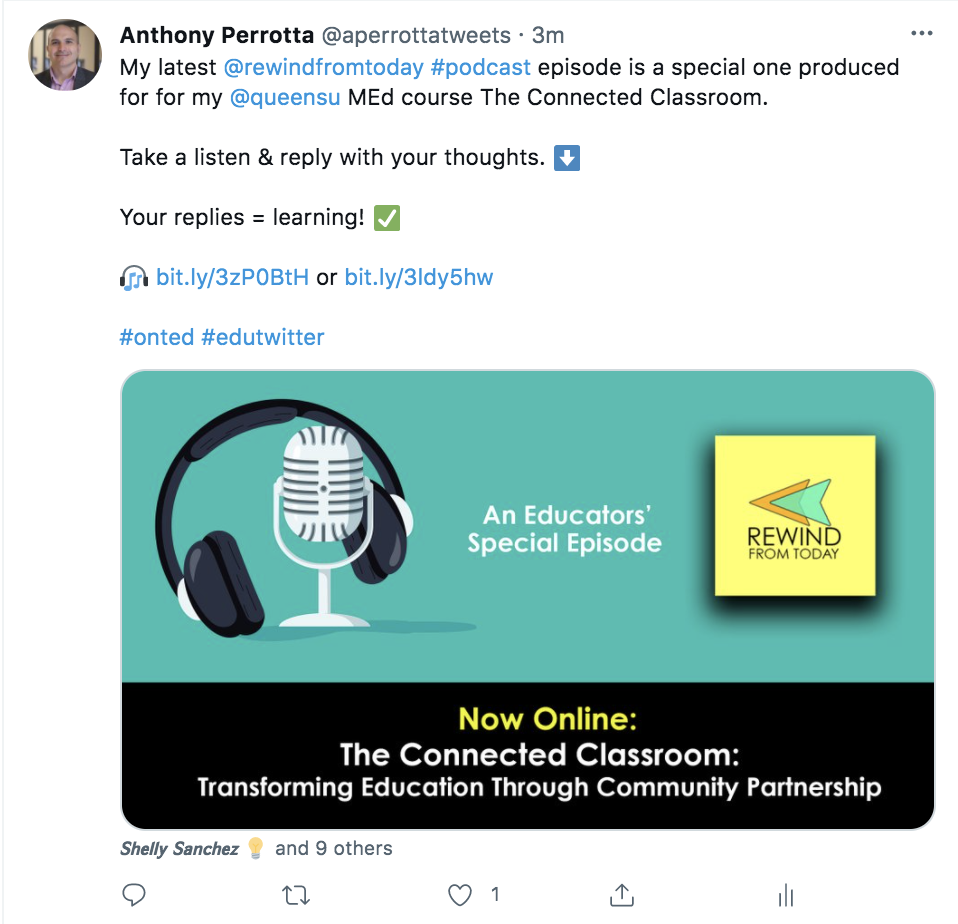
With all of this, my latest Rewind From Today episode is an educators’ special titled The Connected Classroom: Transforming Education Through Community Partnership. Specifically, I explore two community organizations (Campus Calgary and MusicLinks) through Networked Learning and Interdisciplinary Learning Theory. The episode lays the foundation for what is an important conversation about school culture today, reimagining learning and the role technology can play to enrich schooling that promotes student interests, creativity and asking questions in active, communal and global ways.
Listen to the podcast below and share your comments with me on Twitter. As you listen, reflect and share what The Connected Classroom means to you.
Hodgson V., McConnell D., Dirckinck-Holmfeld L. (2012) The Theory, Practice and Pedagogy of Networked Learning. In: Dirckinck-Holmfeld L., Hodgson V., McConnell D. (eds) Exploring the Theory, Pedagogy and Practice of Networked Learning. Springer, New York, NY.
Utecht, J., & Keller, D. (2019). Becoming Relevant Again: Applying Connectivism Learning Theory to Today’s Classrooms.
Over the course of the past few years and most certainly during COVID, much has been said and written about resiliency. Just Google search “resilience and COVID” and you will find countless articles from scholars to basement bloggers like me.
We’ve come to use the term so loosely.
When it comes to schooling, I can’t count how many times I’ve heard that “kids are resilient.”
Are they? If so, to what extent?
As a parent and educator, my concern is that students may have hit their max load with all things COVID, Zoom, Google Classroom and the constant changes between in-school and remote learning that has isolated so many. For a young person to be resilient, a set of skills along with a mindset needs to be nurtured. It’s not easy.
I’m forty, educated, privileged and have struggled during the past 16 months. I’ve been afforded opportunities to embrace self care and know how to self-regulate to some extent. I’m resilient up to a point – I’m still learning.
Thus, why do we insist that students are resilient when a framework to embed such practices in may schools and districts are lacking. For example, the Centre of Child Development at Harvard University has done exceptional work supporting families and staff during the COVID pandemic. The centre notes that resiliency “can help us get through and overcome hardship. But resilience is not something we’re born with—it’s built over time as the experiences we have interact with our unique, individual genetic makeup. That’s why we all respond to stress and adversity—like that from the COVID-19 pandemic—differently.”
As shared, resilience is something that must be taught. Unfortunately, it’s become part of the toxic positivity vernacular that is doing more harm than good. Rather than leaning into vulnerability and required action, we’ve walked away from what truly matters. How can we fully expect or assert that students (or staff) are resilient when we’re not necessarily or intentionally teaching them how to be or worse – not building the culture to be. The word resilience is becoming dangerous, as it continues to be appropriated by adults or “leaders” to mask inaction and to deflect responsibility at the most critical of times.
We’re trying to convince ourselves that kids are resilient, as a justification for giving them less of what they actually need. This facade, has the potential to greatly erode a students’ ability to achieve their success. COVID should have reminded us that students, and all those who make learning possible, need more of the good and not less. Specifically, students need self-regulation skills to ensure their ability to be resilient. Resilience is not born out of hardship but is a response to it. Thus, safe and nurturing places need to exist where resiliency can grow and be utilized during the most challenging of times. From smaller class sizes in response to COVID in schools to truly measuring the workload for staff in all sectors, a culture of well-being is needed more now than ever. However, rather than taking away stressors, more continues to mount.
Thinking about COVID and the school year ahead, I can’t help but play a scene from Netflix’s Fear Street: 1978 in my head.
A horror trilogy based on R.L. Stines’ Fear Street book series, the films provide a window into deep conversation about generational trauma and teenage anxiety. Centred around the gruesome killings in Shadyside, a town plagued by a history of violence, a group of teens navigate a century old curse.
The second film, Fear Street: 1978 pays homage to all things Friday the 13th with a Crystal-Lake-esque camp setting. As a teenage girl is bullied beyond measure, she has an encounter with her older sister who is also a camp counsellor. In a tense conversation about family, identity and community, the younger sister asserts that everyone is “cursed.” This is to say that everyone arrives at a particular time and place with their own hardships and potential realities.
Still from Fear Street: 1978
This particular scene resonates so deeply as it speaks to the both “Small and Big T” trauma that shapes individual lives. Reflecting on the past 16 months, we’ve all been through some sort of trauma. We’ve all navigated what feels like a cursed world. This is not to be negative or a pessimist but rather honest and truthful about the challenges we’ve faced and the road ahead. There’s been plenty of good but also plenty of bad. We can’t avoid the bad. In doing so, the toxicity will take over.
Students, parents, caring-adults, teachers, administrators and all who make schooling happen, have been through so much. Exhaustion is elevated, stress is mounting, unknowns are in abundance and thus now is the time for intentionality, action, support, empathy, deep care and renewed mindset.
With all of this, students and educators alike, will be arriving back to school this August and September after being through so much. We cannot expect them to be resilient and we need the support in place that will allow schools – and people – to truly thrive.
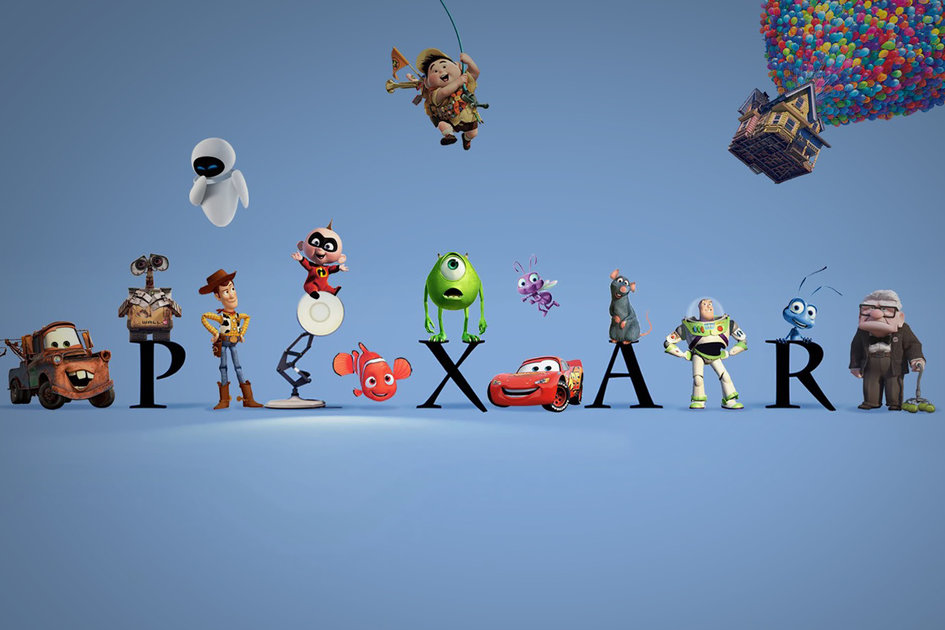
More so than any other studio, Pixar has been consistent in its output of family friendly films that don’t shy away from the complex narratives that shape the shared experience of movie goers. From the studio’s first feature Toy Story (1995) to its most recent Luca (2021), the Pixar canon is a growing mosaic of childhood memories, family trauma, cultural dialogue and ultimately the importance of love.
From the adults watching with young children, or young children watching as they grow older, the studio has always respected audiences’ ability to embrace the nuances of their stories. Pixar films have never been what many would expect from an animated movie. The films are not “kid movies,” but family friendly in that they provide a safe place to share time together while thinking about what makes life so joyous, heartbreaking and ultimately blessed.
So, whether you plan to watch or even rewatch Luca, there’s a unique opportunity to dive into the narrative with an understanding that popular film has the ability to both influence and reflect culture. In many ways, Luca attempts to do both in it’s telling of two young sea creatures who in human form look to fit in, have their dreams fulfilled but who also yearn to be fully seen in a world they fear will not accept them.
Before you begin to watch with young children, take the time to set the tone of the movie. Directed by Italian filmmaker Enrico Casarosa, Luca raises out of Italian cinema’s social consciousness and visual sensibilities that merge fantasy with the real world. Like Casarosa’s short film La Luna, Luca is a movie about family, finding one’s path and the imagination that inspires the dreams that shape a childhood.
Watch La Luna below:
After watching La Luna, ask your child about their dreams and aspirations. Ask them about what makes them unique and special. Share time, where your child feels fully seen.
An interesting way to shape this time of sharing is to have your child make a vision board before watching the movie. A vision board is how your child sees themselves and also gives them an opportunity to share their goals and aspirations.
This vision board allows your child an opportunity to create and share. For some insight into vision boarding, read this article from Oprah Daily.
Have your child present their vision board. Take the time to discuss what your child shares.
Luca deserves to be fully experienced. Make popcorn, get your snacks ready and fully engulf yourself into the movie experience. Watch the movie more than once – first to enjoy as entertainment and then the second to “read” critically.
As your child watches for the first time, keep in mind some big ideas that director Enrico Casarosa presents and the time in which he presents them. Developed at a time when Italy was on the front line of migration from Libya, growing populous mandates and the era of Trump, his film truly raises from the political and speaks directly to concerns about “otherness,” and belonging.
Equally, leaning into Italy’s connection to early horror cinema and anxieties around otherness, Luca could easily be a horror movie of the Universal Monster Era as two sea creatures in the human world try to find their way. Misunderstood, they become the target of townspeople’s ignorance, prejudice, hate, privilege and bias.
Ultimately, in their encounters the audience is reminded that the sea creatures are not monstrous but rather the marginalization and hate that others create. The “otherness” is the monster and reflective of those people unwilling to give and understand. In fact, the scene in which Luca and Alberto are exposed during the race is very reminiscent of the classic horror film Frankenstein.
As they race away from Erocle and help Guilia to her feet after a bad fall, the town has an intense movement of reaction. As Luca and Alberto are swarmed as their sea creature selves come to be known, they can be anyone or any group who have been threatened, marginalized, maltreated and harmed for who they are. Not being fully seen, the immediate reaction is to disregard Luca and Alberto. Like Frankenstein’s monster, they are innocent but made to be monsters.
However, love and acceptance comes forward in the shape of Guilia’s father who fully sees Alberto and Luca. He knows who they are. He, a man without an arm, sees the two boys fully and understands the way in which people are looking at them. Like him, the boys regardless of their creature form, deserve dignity and to be fully seen.
Nonetheless, as you watch, think about the sea creatures and what they represent culturally. Ultimately, they represent all who do not fit within a prescribed sense of social normality; those made to be outsiders. Luca and Alberto represent the need for equity and inclusivity in all of our lives.
Every family has their own sensibilities when it comes to cultural narratives that shape our shared experience.
For example, in my household my wife and I are quite open when it comes to issues of equity and inclusivity. As such, it was not new for my children to engage in a conversation about culture and history after watching Luca.
With my own 10 and 8 year old children, Luca provided an opportunity to talk about truth and reconciliation as it pertains to Canada’s past and present in relation to Indigenous peoples.
As Canada looks to its true history with the recent discoveries of unmarked graves of children who died in and because of Residential Schools, Luca provided an opportunity to speak about realities where people may not want to identify who they really are out of fear. This connects to data pertaining to students in Canadian schools who may not openly identify as Indigenous in fear of reprisal. Thus, the key is to understand why the “otherness” exists and how to change a culture of hate.
Navigating the conversation based on where our children are, Luca provided a window in which to open dialogue about “otherness” and the need for our children to be allies who fully see their peers and empower them to be who they really are.
If this is not the conversation you’re ready to have with your children, then leverage Luca as an opportunity to speak about the importance of kindness and to respect all that make our communities diverse and unique.
Have this conversation while your child creates. See below for a collection of Luca activities.















 Anthony Perrotta
You must be logged in to post a comment.